Real Estate SMS Marketing for Investors: What to Know About Automation and Compliance
@rentalincome255
Real estate investors love texting for a simple reason: it reaches people fast. A seller who ignores an email may read a text in minutes. A missed call can turn into a conversation if a follow up message lands at the right time. For acquisitions teams working off market property leads, that speed matters.
But speed creates risk when the system behind it is loose. The same automated SMS that helps one investor stay organized can get another investor filtered by carriers, ignored by sellers, or dragged into preventable compliance trouble. I have seen teams focus so hard on volume that they forget the basics: who they are contacting, why they are contacting them, whether their records are clean, and whether their process respects the rules that govern business texting and telemarketing activity.
That is the real conversation around real estate SMS marketing. It is not just about blasting more messages. It is about building a repeatable follow up machine that works in the field, fits how acquisitions actually happen, and does not collapse under compliance mistakes.
Why texting became central to investor follow up
Most real estate investor lead generation systems produce mixed quality. A list may include inherited property owners, vacant property owners, older tax delinquent records, or other kinds of distressed property leads. Some people are truly motivated seller leads. Others are not interested at all. Some are open to an offer six months from now, not today.
That mismatch is why automated lead follow up became so important in real estate investing software. Investors rarely win deals by making one call and moving on. They win by staying in contact long enough for timing and motivation to line up.
SMS fits that reality well. It is less intrusive than a call, easier to answer than an email, and simple to route through a real estate investor CRM. For a solo wholesaler, texting can create a lightweight follow up system. For a larger acquisitions team, real estate SMS automation can help with intake, reminders, appointment setting, and reactivation of older seller leads.
The key is understanding what automation should and should not do.
Automation is good at consistency. It can send a missed call text back. It can trigger a follow up when a web form comes in. It can remind an acquisition manager to respond when a seller goes quiet. It can organize conversations across channels. A strong real estate follow up system makes those actions feel seamless instead of chaotic.
Automation is bad at judgment when the campaign itself is sloppy. If the list is poor, the message is weak, or the records are inaccurate, an automated system just scales the problem. That is true whether you are using a basic SMS automation software setup or a broader investor CRM with AI lead follow up features.
What investors usually mean by SMS automation
When investors talk about automated SMS for real estate investors, they usually mean one of three things.
First, they mean workflow automation. A lead comes in from PPC, SEO, direct mail response, cold calling, or some other real estate prospecting source, and the system starts seller lead follow up automatically.
Second, they mean campaign automation. A lead list is loaded, often based on property data, owner data, or skip tracing for real estate investors, and the platform sends text outreach at scale.
Third, they mean conversation automation. A platform helps handle replies, qualify seller motivation, route hot leads, and keep the pipeline moving. Some tools now blend SMS with voice, email, and other channels so one lead record does not live in five disconnected https://kamerontdik877.evercolumn.com/posts/real-estate-lead-qualification-with-ai-voice-assistants-and-automated-workflows-2 places.
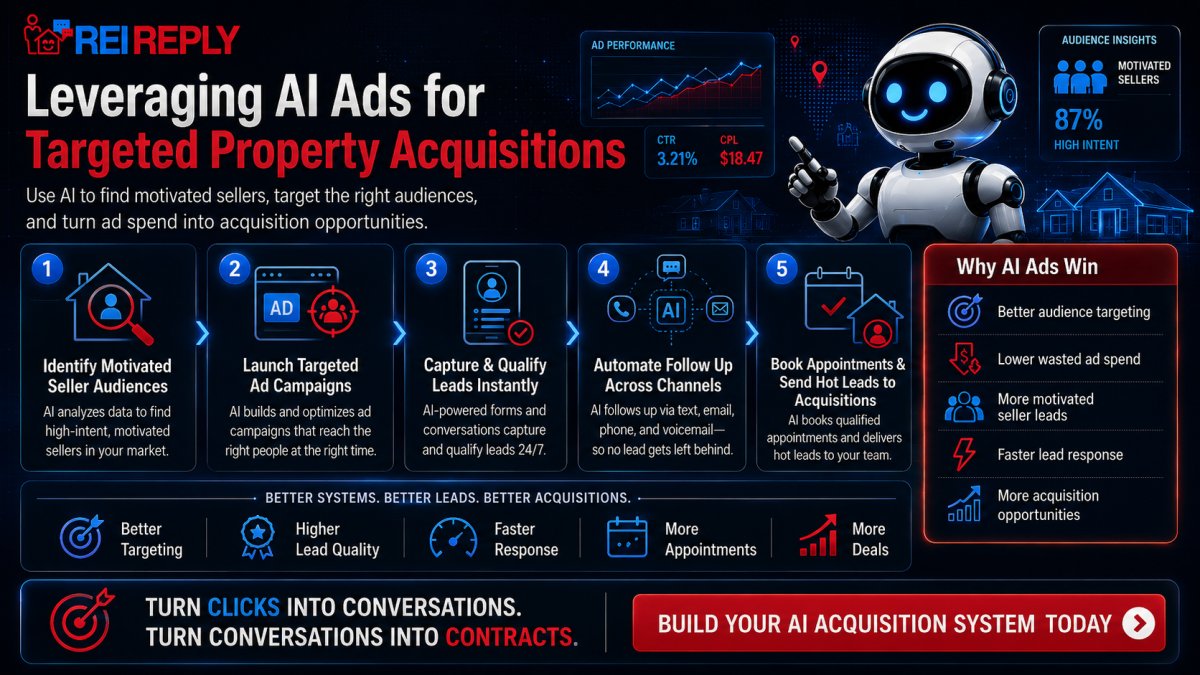
This is where platforms built around real estate investor automation have found traction. REI Reply, for example, positions itself as a CRM and follow up system built specifically for real estate investors. Its public positioning is not that it sells leads as a core lead provider. It presents itself as a conversion engine for leads investors are already generating, while also stating that a subscription includes access to verified motivated seller data through REI AI Leads. It also markets a stack that combines inbound and outbound calling, SMS, missed call text back, and AI voice assistants, with workflow features aimed at acquisitions teams and operators working PPC, SEO, cold calling, or SMS outreach.
That positioning makes sense from an operations standpoint. Real estate investor leads often come from scattered sources. If inbound calls sit in one app, outbound texts sit in another, and seller lead management lives in a spreadsheet, follow up quality falls fast. A unified platform can help an investor track the life of a conversation from first touch through qualification and appointment booking.
Still, centralization is not the same as compliance. Software can support a good process, but it does not magically create one.
The compliance side investors cannot afford to treat casually
There is a common mistake in this space. Investors assume that because texting feels informal, the rules are informal too. They are not.
If your outreach touches telemarketing activity, Do Not Call obligations matter. The Federal Trade Commission says telemarketers must honor Do Not Call rules, cannot use the National Registry or entity specific Do Not Call lists for any purpose other than compliance, and generally may not call outside 8 a.m. To 9 p.m. Local time without prior consent. That alone should change how investors think about real estate lead follow up. Time zones, opt outs, and internal records are not housekeeping details. They are foundational.
Another area that gets misunderstood is prerecorded calling. The FTC says prerecorded telemarketing calls require prior signed, written agreement, and that consent can be obtained electronically if E-SIGN requirements are met. For investors exploring voice AI for real estate investors, AI phone agent real estate workflows, or an AI voice agent that handles motivated seller calls, that is not a small footnote. It is a major design constraint. If a team wants to add real estate call automation or a real estate AI receptionist into the mix, they need to understand exactly what kind of calls are being made and what level of consent is required.
None of this means investors should avoid automation. It means the automation should be built around compliance, not layered on top of a messy outbound process.
A2P 10DLC is not a technical side quest
A lot of investors first hear about A2P 10DLC when their text message deliverability starts slipping. Messages that used to land stop getting responses. Carrier filtering increases. Volume becomes erratic. Suddenly the acquisitions team is convinced that “texting is dead,” when the real issue is usually that the sending setup is wrong, incomplete, or hard for carriers to trust.
Twilio describes A2P 10DLC as the U.S. Carrier standard for application to person SMS traffic sent through 10 digit long code numbers, designed to ensure messages are verified and consensual. For real estate SMS deliverability, that matters more than most investors realize.
When you run automated text messaging through a business operation, especially at any meaningful scale, carriers want to see a legitimate, verified use case. They care about who is sending, what kind of traffic is being sent, and whether the messages appear to be consensual. That affects real estate texting compliance and practical performance at the same time. You are not just registering paperwork for the sake of paperwork. You are giving carriers a framework for how your traffic should be classified and handled.
That is why A2P for real estate investors belongs in the planning stage, not the cleanup stage. If you wait until after your real estate SMS automation starts underperforming, you are already losing time and lead flow.
Deliverability is partly technical, partly behavioral
Investors often want a trick for text message deliverability, some magic phrase or formatting tactic that gets past filtering. In practice, deliverability is more basic and more unforgiving.
Carriers do not only look at infrastructure. They also react to patterns that look abusive, deceptive, or low quality. When outreach is too aggressive, too repetitive, or poorly aligned with a legitimate business use case, it tends to cause trouble. That is one reason many real estate marketing automation tools now talk openly about text deliverability oriented messaging features.
REI Reply, for instance, promotes features such as Spintax and Humanizer style messaging tools along with automated follow up and AI seller conversations. The appeal is obvious. Investors want to avoid sending stale, robotic text that gets ignored or filtered. But this is where judgment matters. Variation for the sake of sounding more natural is one thing. Using variation as a substitute for a compliant, consent aware, well targeted campaign is another. No wording trick fixes a broken contact strategy.
The investors who tend to perform best with SMS follow up are usually disciplined in quieter ways. Their lead data is cleaner. Their timing is deliberate. Their CRM for real estate investors is set up to suppress people who should not be contacted. Their records show when a lead came in, how the seller engaged, and whether the seller asked not to be contacted again. Those habits sound boring until they save a campaign.
The role of data in a text outreach program
Every text campaign begins before the first message. It begins with data.
That may be property owner lookup work, real estate skip tracing, bulk skip tracing, or importing seller lead lists from another source. Whatever the origin, the quality of that data shapes everything downstream. If phone numbers are stale, mismatched, or poorly documented, your real estate investor texting operation will waste money and frustrate people. If the source and intended use of a list are unclear, your compliance risk rises.
This is especially relevant for teams trying to find motivated sellers at scale. There is always pressure to widen the funnel. Investors add more off market data, more property data for real estate investors, more owner records, more vacant and distressed segments. But quantity has a cost. As lists broaden, relevance often drops. The result is more volume with weaker engagement, more opt outs, and a tougher deliverability environment.
Good seller lead generation is not just about more names. It is about better fit and better follow through.
That is why a real estate lead management system matters so much. A strong investor CRM does more than store contact records. It creates continuity. It shows who responded, who asked for a callback, who is not ready, who booked an appointment, and who should never be contacted again. Without that continuity, automated seller follow up becomes repetitive and careless.
Where AI helps, and where it still needs supervision
There is real interest right now in AI for real estate investors, especially around AI lead management, AI lead qualification, AI follow up, and AI real estate CRM workflows. Some of that interest is justified. A system that can classify inbound responses, route hot leads, book appointments, and keep older conversations alive can create serious operational leverage.
REI Reply’s public marketing speaks directly to that demand. It says its AI voice agent can qualify leads, book appointments, and follow up 24/7 across calls, SMS, email, and socials. For an acquisition shop that misses calls after hours or struggles to work every inbound lead quickly, that kind of automation can be attractive.
Used well, AI can reduce lag time, especially in the first few minutes after a seller raises a hand. It can support real estate lead nurturing without requiring a human rep to manually touch every record every day. It can help an acquisitions manager focus on the best real estate acquisition leads instead of drowning in admin.
Used poorly, it creates a different set of problems. It can make conversations feel canned. It can mishandle edge cases. It can over message people who should have been suppressed. It can escalate a bad compliance practice faster than a human team ever could.
That is why I think of AI real estate investing tools as force multipliers, not replacements for operator judgment. A real estate AI assistant can speed up response handling. It cannot decide your risk tolerance for outbound outreach. An AI CRM for real estate investors can make lead nurturing real estate workflows more efficient. It cannot decide whether your recordkeeping is strong enough to defend your process.
What a practical SMS workflow looks like
The most effective real estate SMS marketing setups are rarely the flashiest. They are clear, documented, and easy for the team to follow. They usually answer a few core questions before any campaign launches.
- Where did this lead or number come from, and how is that documented?
- What should happen if the person replies, opts out, or asks for a call later?
- How will the system prevent outreach at the wrong local time?
- Who reviews message logic, suppression rules, and CRM hygiene on a regular basis?
- If AI or voice automation is involved, what human oversight exists?
Those questions matter whether you are a solo wholesaler using basic automated text messaging or a larger acquisitions team using a real estate automation software stack with SMS, calls, and AI seller conversations.
In practice, the workflow often looks less glamorous than the marketing promises. A seller lead comes in. The CRM sends an immediate acknowledgment. If the seller replies, the lead is routed for qualification. If there is no response, a timed follow up sequence continues, but only within the rules and guardrails the business has established. If the seller asks not to be contacted, the record is updated immediately and all future outreach stops. If a call is missed, a missed call text back may fire. If the lead is hot, a human acquisition rep takes over quickly.
That kind of handoff is where many teams fail. They buy a motivated seller CRM or real estate wholesaling CRM expecting automation alone to solve conversion. But conversion usually breaks at transition points: when a reply sits too long, when notes are not updated, when a cold lead gets treated like a hot lead, or when the acquisition manager does not trust the system and starts working from a personal phone.
The software question investors should ask first
When investors shop for the best CRM for real estate investors, they often ask about features first. Can it text? Can it call? Does it support AI lead follow up? Can it help with seller lead automation or bulk SMS real estate campaigns?
Those are fair questions, but I would ask a different one first: does the platform match your operating style?
A solo investor working a narrow farm area may need a simple real estate sales pipeline and clean SMS follow up. A wholesaling team working paid traffic, cold outreach, and inbound calls may need a larger real estate investor software system that keeps channels unified. A business leaning heavily into AI calling real estate workflows may care more about appointment routing and around the clock coverage.
REI Reply is an example of a platform that clearly aims at the latter kind of operator. Its positioning speaks to wholesalers, fix and flippers, buy and hold investors, and acquisitions teams that already have lead flow coming from PPC, SEO, cold calling, or SMS outreach. It presents itself as the machinery that converts and manages those opportunities, not simply as a list vendor. For some teams, that combination of CRM, calling, SMS, and AI voice agent support can be operationally attractive.
But even the right platform will not rescue a weak process. Real estate marketing software is most valuable when the business already knows how it wants leads handled.
What experienced investors tend to get right
There is a pattern I have noticed with investors who maintain healthy SMS programs over time. They do not talk about texting as a hack. They treat it as part of a lead management discipline.
They respect timing. They keep better notes. They do not let opt out handling become an afterthought. They understand that real estate follow up automation must still feel coherent to the seller. They know that one seller may want a direct phone conversation while another prefers short text updates for weeks before agreeing to talk seriously.
Most important, they accept trade offs. A more aggressive outreach posture may create more immediate conversations, but it can also create more complaints, more filtering pressure, and more operational noise. A more conservative posture may slow the top of funnel, but it often improves lead quality and protects deliverability.
That balance is where mature real estate SMS marketing lives. Not in the fantasy of infinite automation, but in the discipline of knowing what should be automated, what must be reviewed, and what should always stay in human hands.
The bottom line for investors building an SMS engine
SMS for real estate investors works best when it sits inside a complete system. That system includes lead sources, data handling, compliance rules, CRM structure, follow up logic, and human accountability. Leave out any one of those pieces and the whole thing gets shakier.
Automation has real value. So does AI in the right workflow. A platform that unifies calling, text message marketing real estate efforts, missed call text back, seller lead follow up, and even AI voice support can create meaningful leverage for acquisitions teams. That is the appeal behind tools like REI Reply and the broader push toward real estate investor automation.
But leverage cuts both ways. If your process is sound, automation helps you respond faster, follow up longer, and manage more conversations without dropping leads. If your process is careless, automation simply helps you make the same mistakes at scale.
For investors, that is the central lesson. Build the compliance discipline first. Understand A2P 10DLC and why it affects business texting. Respect Do Not Call rules and time restrictions. Be careful with any prerecorded or voice automated telemarketing activity that may require prior signed, written agreement. Keep your real estate lead data organized, your CRM records current, and your follow up logic grounded in how real seller conversations actually unfold.
Do that well, and real estate SMS automation becomes more than a convenience. It becomes part of a durable acquisition system.